Cite from Brittanica ˝Method of dyeing textiles, principally cottons, in which patterned areas are covered with wax so that they will not receive colour. Multicoloured effects are achieved by repeating the dyeing process several times, the initial pattern of wax being boiled off and another design applied before redyeing. Wax was applied with bamboo strips in Indonesia, where the technique originated. A small copper pot with a handle and narrow applicator spout for applying the wax came into use in Java by the mid 18th century; a wood-block wax applicator was developed in the 19th century. Dutch traders imported the cloth and the technique to Europe. Today machines for applying wax in traditional Javanese patterns reproduce the same effects as the hand-dyeing process.˝
Cite from Wikipedia˝Batik (Javanese-Indonesian pronunciation: [ˈba.teʔ], but often, in English, is [ˈbætɪk] or [bəˈtiːk]) is an Indonesian word and refers to a generic wax-resist dyeing technique used on textile. The word originates from Javanese word "amba", meaning ”to write” and the Javanese word for dot or point, "titik."
It is known to be more than a millennium old, probably originating in ancient Egypt or Sumeria. There is evidence that cloth decorated through some form of resist technique was in use in the early centuries AD.[citation needed] It is found in several countries later in West Africa such as Nigeria, Cameroon and Mali, or in Asia, such as India, Sri Lanka, Bangladesh , Iran, Thailand, and Malaysia, but the most popular are in Indonesia. The art of Batik reached its highest achievement in technique, intricate design, and refined aesthetic in Java, Indonesia. The island of Java has been well known for its exquisite batik for centuries, particularly in places such as Yogyakarta, Solo, Cirebon, and Pekalong
Procedure
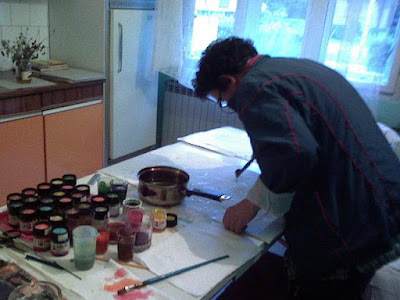
Melted wax is applied to cloth before being dipped in dye. It is common for people to use a mixture of bees wax and paraffin wax. The bee's wax will hold to the fabric and the paraffin wax will allow cracking, which is a characteristic of batik. Wherever the wax has seeped through the fabric, the dye will not penetrate. Sometimes several colors are used, with a series of dyeing, drying and waxing steps.
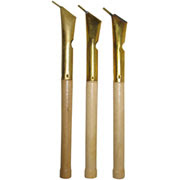
Thin wax lines are made with a canting needle, a wooden handled tool with a tiny metal cup with a tiny spout, out of which the wax seeps. Other methods of applying the wax onto the fabric include pouring the liquid wax, painting the wax on with a brush, and applying the hot wax to precarved wooden or metal wire block and stamping the fabric.
After the last dyeing, the fabric is hung up to dry. Then it is dipped in a solvent to dissolve the wax, or ironed between paper towels or newspapers to absorb the wax and reveal the deep rich colors and the fine crinkle lines that give batik its character.
The invention of the copper block or cap developed by the Javanese in the 20th century revolutionised batik production. It became possible to make high quality designs and intricate patterns much faster than one could possibly do by hand-painting.
Indonesian batik used for clothing normally has an intricate pattern. The traditional ones carry natural colors while the contemporary ones have more variety of color. Some batik may be mystic-influenced, but very rarely used for clothing. Some may carry illustrations of animals and people.˝
Basic tool for batik technique is
Tjanting - small reservoir for direct applying hot melted wax
Tutorial coming soon
 In this short batik tutorial you will learn how to make beautiful paintings in simplified batik on canvas technique.


